Sunday, October 14, 2012

Family calls for Common Identity and Language, Human Rights and Religious tolerance in Constitution Submission


SUVA, FIJI ISLANDS
Sunday 14th October, 2012

Maelin Pickering Bhagwan with children Francisco-Xavier
and Antonia Bhagwan  outside the GCC Complex in Suva
on Satuday 13/10/12 after making her submission to the
Constitution Commission
A mother of two made a submission to the Constitutional Commission on Saturday and called for a constitution that while upholding universal principles and international conventions and norms, must reflect the uniqueness of Fiji.

Maelin Bhagwan, a high school teacher presented a submission in Suva on Saturday (13/10/12) on behalf of her husband Rev. James Bhagwan, who is currently a post-graduate student in Korea.

In a 12-page submission, Mrs. Bhagwan presented proposals concerning the issues of Common Identity; Common Language; Citizenship; Religious Tolerance and Human Rights; Participation in Decision-making; and Religion and the State.

The submission included proposals for:

A common identity - All citizens of Fiji to be known as Fijians with the historical Identity of indigenous Fijians and Rotuma and resettled Ocean Islanders to be maintained through the use of Kai Viti, Kai Rotuma, Kai Rabi.

Common language - Vosa Vaka Viti be the National Language of Fiji, while English, Fiji-Hindi, Rotuman and Vosa Vaka Viti be classified as Official Languages of Fiji. Vosa Vaka Viti to be compulsory subject at all registered educational institutions. (Up to Certificate of Proficiency level.)

In making her family’s submission, Mrs Bhagwan called for a mechanism in which all Fijians regardless of their heritage may be able to part of the Vanua, as members of the community, with equal responsibility and recognition.

“We believe that we who are born and raised here, or who have adopted Fiji as their home, must have a place within the Vanua,” she said.

“At the same time, and further to our submission on Provincial Identity, we humbly ask not only your consideration, but through your good offices, that the traditional leaders of the Vanua reconsider their understanding of both who they consider themselves leaders of and who constitutes the Vanua.?

“My husband and I are both from Rewa. My husband’s forefathers settled in Vuci and I have maternal links to Lomanikoro. My husband is also vasu i Macuata. While we teach our children about their diverse ethnic and cultural heritage, at the same time we want them to also be Fiji’s children and have their links to Rewa and Macuata recognised. We want them to know and understand who and what their vanua is, who their high chief, and understand what that means for them.”

“This is not just for the minorities who have some blood ties to the Kai Viti. We believe that this is important for all Fijians regardless of ethnic background as it adds to social cohesion through a sense of belonging and commitment to the wider community. “

“All chiefs should be encouraged to practice inclusive leadership of all people in their villages, districts and provinces. This, we believe, will not only help in the development of common identity and common or national culture, but also benefit the Vanua as many more people will be able to contribute to development and stewardship of its resources.”

The submission also addressed the issues of Human Rights and Religious Tolerance, calling for the Strengthening of the Obudsman’s Office, affirmation of the Bill of Rights in the 1997 Constitution and the maintaining of a Human Rights Commission along with the establishment of two new commissions: A Fiji Interreligious Council comprising all faith based organisations and registered religious groups; and a Commission for Reconciliation and Peacebuilding to focus on restorative justice issues.

On the issue of Religion and State, Rev. and Mrs. Bhagwan proposed that the commission look at the option of Civil Religion. “Civil religion is comprised of a sacred system of beliefs, myths, symbols, and ceremonies that give meaning to the concepts of "nation" and "state." Civil religion presents an understanding of a society's role in history and each person's role as a citizen. In other words, a civil religion is an expression of the cohesion of the nation. It transcends denominational, ethnic and provincial boundaries.”

Wednesday, October 10, 2012

True Independence is Interdependence

Published in the Fiji Times "Off the Wall with Padre James Bhagwan," on Fiji Day, Wednesday October 10th, 2012


Happy Fiji Day!
While some of us are putting up a flag and putting down a lovo, others are squeezing out a mix while wishing they had the money to buy the ingredients for a lovo. My family, under the direction of our great matriarch, Rachel, will spend the morning celebrating Fiji Day with the senior citizens in Samabula. Some will have a day off from work and enjoy a sleep-in in the morning, while others will work in the essential services or out of necessity. Some of us (meaning me) will have to go to class. Regardless of where we are and what we are doing today we commemorate 42 years of independent Fiji.
Well maybe.
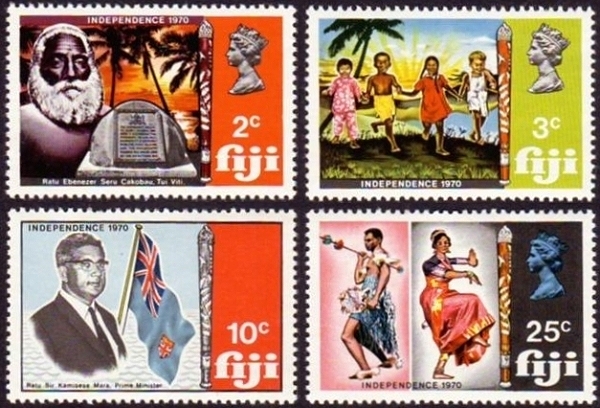
By “maybe” I do not mean that we do not commemorate the occasion at Albert Park on 10th October, 1970, when Prince Charles handed the (now missing) instruments of independence to the late Ratu Sir Kamisese Mara and when the Union Jack was lowered, the Fiji Flag was raised and the national anthem sung for the first time.

 I do not mean that we do not take time to remember the day when leaders of the different faith communities gathered together in mutual respect and tolerance to seek, in their diverse ways, that God would truly grant God’s blessings on the “isles of Fiji.” I do not mean that we do not relive, through a march from the Suva Flea Market to Albert Park, the excitement of citizens – some adults, many children in their colourful school uniforms – watching history unfold.


What I mean by “maybe” is that while we celebrate 42 years of Independence from Great Britain, we are still struggling to loosen shackles. Shackles of colonialism embedded in our culture, our traditions, our politics, our economics, our society, our history, and our identity. The shackles may be transparent or may look like pretty bracelets or bangles passed down through generations. But they are shackles none the less.

On Sunday, members of the Fiji Community in Korea living in Seoul who were available attended a church service together to mark the beginning of our Fiji Day celebrations. The group included the family of Fiji’s first resident Ambassador to South Korea, staff of the Fiji Embassy and Fijians studying in Korea and a few from China.

The service was held at Chungdong First Methodist Church, the first Protestant church in Korea. Established and started in 1885 by the pioneer American missionary Henry Appenzeller, the church has always been a vital meeting point between East and West and a place where the beauty of diversity is celebrated in God's unity. It also published Korea’s first monthly magazine, “Gyohoe,” in 1889, with the goal of propagating liberal thought in Korea. Rev. Appenzeller also founded the nearby Pai Chai Boys School, while fellow Methodist missionary Mary Scranton established Ewha Girls School.


We offered a hymn as a way of saying thank you to the community of Chungdong and guest preacher, Rev. Dr. Joseph Robert Dongell (Professor of New Testament Studies at Asbury University) for his inspiring sermon on “The Great Gap”. We sang the popular hymn “Au Rai Vei Kemuni” (I need thee every hour).

The gathering at church was significant because it was also World Communion Sunday. For Christians this serves as a reminder that we are part of one body, the body of Christ. For Fijians from different backgrounds, provinces and islands it was reminder that we are one people.

Yesterday (Tuesday) the Fiji Embassy in Seoul commemorated Fiji Day with a Fiji/Korea Investment seminar and a reception in the evening. Today (Wednesday) Fijians based in the coastal city of Busan will be having an informal gathering with Ambassador Kau and Minister for Youth and Sports, Commander Viliame Naupoto.

During the service on Sunday the congregation sang a hymn by Fred Kaan, titled, “For the Healing of the Nations.”

For the healing of the nations, 
Lord, we pray with one accord, 
for a just and equal sharing
of the things that earth affords. 
To a life of love in action 
help us rise and pledge our word.

Lead us forward into freedom, 
from despair your world release, t
hat, redeemed from war and hatred,
all may come and go in peace. 
Show us how through care and goodness 
fear will die and hope increase.

All that kills abundant living,
 let it from the earth be banned:
 pride of status, race or schooling, 
dogmas that obscure your plan.
 In our common quest for justice 
may we hallow brief life's span.

You, Creator God, have written 
your great name on humankind; 
for our growing in your likeness
bring the life of Christ to mind;
 that by our response and service
earth its destiny may find.

I felt it was an appropriate song, not just for World Communion Sunday, but for our prelude to Fiji Day.

Later as we sat together sharing pizza and then some ice-cream, I looked around at our small group that spanned four decades – men and women, some who remember when Fiji was still a British Colony, some who remember early “independent” Fiji and some who have only known a country shaped by political upheaval. Our differences were lost in the laughter and chatter of a people who were happy to have each other in a strange land.


There will come a time when we put our differences aside and freely make the commitment to join hands and walk together into the future. There will come a time when we recognise and celebrate our interdependence as a people, as a nation. That is when Fiji will truly be an independent country.

God bless Fiji.

“Simplicity, Serenity, Spontaneity”

Saturday, October 6, 2012

WACC addresses open letter to Government of Fiji


Public support grows for Akuila Yabaki’s right to communicate

Fijian human rights activist and Methodist clergyman Akuila Yabaki is facing judicial proceedings in his struggle for greater freedom of opinion and expression in his home country.

Currently the Executive Director of the pro-democracy organization Citizens Constitutional Forum (CCF), Yabaki is a member of the Board of Directors of the World Association for Christian Communication (WACC) and President of WACC’s Pacific Region.

Yabaki is facing legal proceedings having been accused of contempt of court by the Government of Fiji. It followed the publication of an article titled “Fiji: The Rule of Law Lost — An Analysis of the Law Society Charity Report 2012”, which appeared in the April 2012 edition of Tutaka, the quarterly newsletter of the Citizens’ Constitutional Forum. Rev. Yabaki is accused of “scurrilous attacks on the judiciary thereby posing the real risk of undermining the authority of the judiciary in Fiji.”

Yabaki was a strong critic of some policies and decisions of the Qarase government of 2000 to 2006, including the early release from prison of persons convicted on charges related to the Fiji coup of 2000, and opposed controversial legislation seeking to establish a Commission empowered to propose amnesty for such persons.

In July this year, Citizens Constitutional Forum issued a media release criticising restrictions on freedom of expression at a time when constitutional reform was being widely discussed.

“The deliberations of the Constituent Assembly must be open not only to public scrutiny but also to comment and debate and this must be allowed even after the President’s assent and subsequently the Bainimarama Government must take immediate steps to ensure that there is debate in all sectors of the community throughout the entire constitution making process to allow the legislators to hear the views of all Fijians and, hopefully, respond to these opinions by assuaging fears, removing doubts and amending policies,” wrote Yabaki.

The Fiji Government’s decision to charge a prominent NGO and its head with contempt of court has been slammed by the New Zealand Law Society. Its president, Jonathan Temm, told Radio Australia’s Pacific Beat he doesn’t believe any crime has been committed.

“They simply reproduced in their material quotes from a Law Society of England and Wales charity report. So what they were actually doing was saying this is what the Legal Society of England and Wales charity said. And it’s on that basis the contempt charges (are) being advanced,” Temm said.

In this context, and in keeping with its mandate to promote communication rights for all, WACC’s Executive Committee has addressed an open letter to His Excellency Brigadier-General Ratu Epeli Nailatikau, President of Fiji, and to the Government of Fiji.

“Alarmed by the case brought against Rev. Akuila Yabaki, who is known to respect the rule of law and to uphold the human rights and constitutional rights of the people of Fiji, the Executive Committee respectfully requests that the case be dropped lest it damage the public image and reputation of the country,” says the letter.

Speaking on behalf of WACC’s members in more than 140 countries worldwide, the Executive Committee affirms the sentiments contained in the “People’s Charter for Change, Peace and Progress” which calls for Fiji to become a more progressive and truly democratic nation.

Read the full Letter here... http://www.waccglobal.org/images/stories/Pacific-Articles/open-letter-fiji.pdf
____________________
The World Association for Christian Communication (WACC) is an international organization that promotes communication as a basic human right, essential to people’s dignity and community. Rooted in Christian faith, WACC works with all those denied the right to communicate because of status, identity, or gender. It advocates full access to information and communication, and promotes open and diverse media. WACC strengthens networks of communicators to advance peace, understanding and justice..


Friday, October 5, 2012

Between a rock and a hard place: A Civil Religion option for Fiji?

Published in the Fiji Times on Wednesday 3rd October, 2012


This week is a long holiday that extended from Saturday until today (Wednesday). Over the weekend was the harvest celebration of Chuseok, the Korean Thanksgiving holiday. This year, Chuseok Day was on Sunday, September 30, but the holiday is observed for a total of three days (September 29 – October 1). It is by far the biggest and most important holiday in Korea. It is a time when family members from near and far come together in their hometowns in the countryside to share food and stories and to give thanks to their ancestors for the abundant harvest. 

Today, 3rd October is Gaecheonjeol, or Korean National Foundation day. This holiday celebrates the creation of the state of Gojoseon (ancient Korea) founded by Dangun Wanggeom in the year 2333 BC. Traditionally Gaecheon (which means "Opening of Heaven") refers to 3 October B.C. 2457, the date when Hwanung (the “Supreme Divine Regent” and son of Hwanin, the “Lord of Heaven”) descended from heaven to live with mankind. Along with his ministers of clouds, rain, and wind, he instituted laws and moral codes and taught the humans various arts, medicine, and agriculture.

It is interesting that these two holidays occur about a week before we of Fiji celebrate our national day marking our independence from Great Britain on October 10th 1970, while also remembering the signing of the Deed of Cession on October 10th, 1874. It is ironic that while the Deed of Cession is kept safely and copies of the text are well read, no one really knows the location or contents of the Instruments of Independence that Prince Charles presented to the late Ratu Sir Kamisese Mara in Albert Park on October 10th, 1970.

Last week as I concluded my fortnightly meeting with my thesis supervisor, I wished him a happy Chuseok and shared my experience last year of spending Chuseok with the family of my Senior Pastor here in Korea. My supervisor asked me if we have any special thanksgiving holidays in which the extended family comes together. I told him about our long weekends during Easter and of Christmas and Boxing Day holidays, as well as Prophet Mohammed’s Birthday and Eid celebrations as well as Diwali and how many of us in Fiji visit each the homes of friends and families during these holidays regardless of our different ethnicities, cultures and religions.

He was quite moved by this and said that despite our problems, Fiji truly had something special.

I noted a comment made a month ago, by a member of the Constitution Commission, Professor Satya Nandan, that the new constitution of Fiji will need to be regarded as a sacred document - created for the people by the people of Fiji so that no one can destroy it.

As I reflected on my supervisor’s comment and Professor Nandan’s statement as well as a recent face-book discussion on the issue of Christian State versus Secular State for, in which I participated – I could not help but wonder if there is a third option for us in Fiji.

How does one invoke or develop a sense of sacredness about a document that may enshrine Fiji as a secular nation, given that the terms sacred and secular are often used to describe two distinct areas of life?

Essayist Peter Saint-Andre writing of the modern dilemma of sacred versus secular writes of a concept of natural religion argues that the concept of the sacred runs deep in the human mind, and that at least some "religious" concepts are potentially universal. We all share in our nature as human beings, and there is much more that we have in common than is peculiar to each one of us.

Saint-Andre suggests that not only can the sacred be secular, but also that the secular can indeed be sacred. He writes: “Who could deny the importance of either our material or our spiritual existence? Both are inherently vital spheres, thrown at war with one another by certain traditions within Western thought.” He calls for the development of what he terms called “natural religion,” and a positive bridging of the destructive gap between the material and the spiritual, the secular and the sacred.

So is there a way in which the sacred and the secular can meet in Fiji? I believe so.

Early last century, eminent sociologist, Emile Durkheim, developed a theory on “Civil Religion”. According to Durkheim, “to the degree a collection of people is a society, it will exhibit a common ("civil") religion.” In other words, a civil religion is what "unites into one single moral community”.

Robert Bellah, another eminent sociologist, writing in the 1960s defined civil religion as "the religious dimension that exists in the life of every nation through which it interprets its historic experiences in the light of its transcendental reality." Civil religion is comprised of a sacred system of beliefs, myths, symbols, and ceremonies that give meaning to the concepts of "nation" and "state."

 Bellah actually based his theory on the United States of America, which while being viewed as a secular state, at the same time holds to "an institutionalized collection of sacred beliefs about the American nation," which is symbolically expressed in America's founding documents and presidential inaugural addresses. It includes a belief in the existence of a transcendent being called "God," an idea that the American nation is subject to God's laws, and an assurance that God will guide and protect the United States.

Bellah saw these beliefs in the values of liberty, justice, charity, and personal virtue and concretized in, for example, the words In God We Trust on both national emblems and on the currency used in daily economic transactions.

Those who support a Christian state may be interested to know that even Israel has a civil religion that connects Judaism and “secular” concepts of nationhood.

Consider the observation about the way that many of us celebrate sacred (holy) days (holidays) irrespective of our religious backgrounds. The many non-Christians who exchange gifts at Christmas, the non-Muslims who visit their Muslim friends and relatives on Eid, the non-Hindus who enjoy the dress, lights, sweets and fireworks of Diwali. Whether we observe that religion or not, we all celebrate it in some meaningful way – even if it means something different to us.

Consider our national unity in excitement, celebration during the Rugby Sevens World Cup in 1997 and 2005, and our nationwide jubilation and celebration recently when Iliesa Delana won Fiji and Oceania’s first gold medal at the Par-Olympics.

Consider also the pledge of allegiance and flag raising ceremonies common to most schools in Fiji. 

Whether imposed from above or emerging from society, civil religion presents an understanding of a society's role in history and each person's role as a citizen.

Perhaps this is a middle ground in which the sacred and the secular can meet.

Perhaps.

“Simplicity, Serenity, Spontaneity”

ENDS

Wednesday, October 3, 2012

Gangnam in a Bollywood Style


I made this clip because I still think that even though PSY's "Gangnam Style" has gone viral and made number one on the UK pop charts, he's got nothing on Bollywood..... just saying... 

Enjoy!


Wednesday, September 19, 2012

Identity and Belonging-ness - Digging Below the Surface of being "Fijian"

Published in the Fiji Times on Wednesday 19th September, 2012 as "What is their place"

The issue of common national identity may different meanings and concerns for Fiji citizens – indigenous, native (Fiji-born) and naturalised – based on their own personal history and experiences and that of their communities.

It ultimately boils down to a sense of belonging to this country, not just in a legal or cultural sense, but also in emotional, psychological and even spiritual senses. From that point view, perhaps we can understand why, while the terms “Fiji Citizen” and “Fiji Islander” may be acceptable with regards to nationality in a legal sense, it may not resonate deeply or adequately express the sense of identity or rootedness that is felt by people who call Fiji “home”.

 Constitutional submissions on common name/national identity from groups who wish to preserve the unique identity of our indigenous brothers and sisters have made a number of proposals for different terms such as “Kai-Viti” for indigenous Fijians instead of “i-Taukei”, and Kai-Idia, Kai-Valagi, Kai-Jaina – to tie Fijians to their heritage. While I can understand, and perhaps even appreciate the concern and perspectives from which this proposals come, I feel that some Fijian communities may slip through the cracks in this type of identification.
 
Take for example the terms “half-caste” and “Kai-Loma”. Originally and from a colonial point of view, a “half-caste” was a mix of “European” and i-Taukei. This was translated into “Kai-loma.” Obviously this understanding of the term had no space for those of mixed i-Taukei and Indo-Fijian heritage, or even the different ethnic groups within the Indo-Fijian community. Now expand that to include every permutation of i-Taukei, Rotuman, Indo-Fijian, Chinese, European, Japanese, Cambodian, Samoan, Tongan, Rabi, i-Kiribati, Tuvaluan and other combination of mixed heritage in Fiji. What do we call them? “Fruit-salad”- while jokingly accepted and less derogatory than “mongrel” - offers very little in terms of identity. These Fijians who embody the very multicultural, multi-ethnic identity we seem to envisage as our future do not have an identity that embraces their diversity. Instead they are forced to choose one aspect of their very being above all others in order to fit in.

To embrace their i-Taukei heritage may mean ignoring their Indo-Fijian ancestors, or vice versa. In this new Fiji that we are trying to build, what is their place?

While we focus on the common term of Fijian, it is important for us to look beyond the surface of identity and belonging – beyond the national level to the provincial level, the community level. We need to acknowledge and name the sense of belonging that many non-i Taukei have to the land of their birth or that they now call home. How do we identify and acknowledge the connection – emotional, or even perhaps spiritual that many of us non- i Taukei have with the Vanua? How do we bridge the gap between the national and the communal?

There is a desire to belong – to not just our country but our city, town, district or village. There is a desire to belong to our province that continues to lie buried, unspoken, unnamed. There is a desire to be a part of a community to which we can contribute, share our skills and resources; a community whose traditional values and culture many wish to embrace; whose traditional leadership we wish to acknowledge, respect and seek.


Many non-i Taukei acknowledge their kaivata, their naita, their tauvu. They consider themselves Kai Suva, Kai Navua, Kai Lautoka, Kai Labasa, Kai Cuvu, Kai Dreketi. They want to be known as Kai Rewa, Kai Nadro, Kai Ba, Kai Bua, Kai Macuata, Kai Tailevu, etc. But how can they seek acknowledgement of that identity that goes with their sense of belonging?

As a Christian I see myself first and foremost as a human being, a creation and child of God. That is my basic starting point for my relationship with all people. As a citizen of Fiji, I consider this to be my homeland. However, I am continually struggling to find a way of expressing my identity as a son of Fiji at home that is acceptable to how others see me.

Like my father before me (born and raised in Vuci), consider myself Kai Rewa. He was very proud to be a Rewan and ex-Lelean. My wife who comes from the Pickering family, also considers herself vasu with Rewa. She is looking forward to the Pickering reunion in Lomanikoro in December this year.

 I have travelled the globe, yet I know no other home but Fiji. I have lived, studied and worked with people from all over the world yet the people I have the strongest relationship with are the people of Fiji – i Taukei, the descendents of the Girmitiya, Kai Loma and every other group that considers Fiji home.

I know that often my thinking and actions are the exception rather than the rule, that sometimes I am not one of the 99 but the 1 missing lamb from the flock. As a member of the Indian Division of the Methodist Church, I am used to being a minority in the Methodist Church, a minority among Indo-Christians, and a minority among Indo-Fijians. There are others also, I’m sure, are used to being a round peg that cannot fit in the square hole.


When I look at my children - who are 6th generation Fiji-born and yet of such diverse ethnic backgrounds that make them possibly the smallest of the minorities - I wonder on what identity will they be able to base their relationships and belonging.

My wife and I will raise them as our children, God’s children. We will teach them about their diverse ethnic and cultural heritage. At the same time we want them to also be Fiji’s children, Rewa’s children. We want them to know and understand who and what their vanua is, who their high chief, and understand what that means for them.

In the final analysis the journey we as a nation are undertaking is not merely a journey for our generations. It is a quest we are undertaking for the future generations who will call these islands home. It is an exodus that leads us from bondage to the politics of separation and culture of suspicion and silence to the freedom to bind ourselves voluntarily to each other in a covenant of trust, community and mutual respect. It is a journey in which we seek merely to find our way home; where we all truly belong, together.

“Simplicity, Serenity, Spontaneity.”

ENDS

Rev. James Bhagwan is an ordained minister of the Methodist Church in Fiji and Rotuma, currently a Masters of Theology student in Seoul, South Korea. Visit the blog: http://thejournalofaspiritualwonderer.blogspot.com or www.twitter.com/padrejb


Wednesday, September 12, 2012

The Struggle for Self-determination


Published in the Fiji Times' "Off the Wall with Padre James Bhagwan," Wednesday 12th September, 2012

As we continue our national journey through the broken reef and towards the calm lagoon in our search to find an island of hope where we as a people can live together in freedom and with respect for all with a sustainable form of democracy that empowers and makes secure every Fijian, it is worthwhile to look around at some of the other islands in Oceania who continue to struggle just for the opportunity to decide how they should be governed.

As we look to a new constitution that will be a living, sacred covenant among all Fijians and towards elections in 2014, perhaps we should remember that while we are wrestling with the difficulties of being an independent nation, there are other islands in Oceania that are still colonies, struggling for self determination.

The term self-determination means: Determination of one's own fate or course of action without compulsion; free will; or freedom of the people of a given area to determine their own political status; in other words, independence.

Last week the Central Committee of the World Council of Churches (WCC), meeting in Kolympari, Crete, Greece, from 28 August to 5 September 2012, issued a public statement calling for re-inscription of the French Polynesia (Maohi Nui) on the list of countries to be decolonized.

In 1947 the French government had Maohi Nui removed from such a list drawn up by the newly formed United Nations. A public statement adopted by the Central Committee calls on French authorities “to fulfil their obligations and provide all necessary means for the economic, social and cultural development of the Maohi people” and “urges France to compensate all those affected by nuclear testing and radioactivity” in the vicinity.

The public statement also invites Christians everywhere to pray “for the people and the churches of Maohi Nui as they embark on their peaceful and just struggle for self-determination.”

According to the statement, the present day French Polynesia (Maohi Nui) became a French protectorate in 1842 and a French colony in 1880, although it was not until 1946 that the indigenous Maohi people acquired French citizenship. By the end of the 19th century, France had annexed all the islands that now constitute French Polynesia. The islands were governed by France under a decree of 1885.

In 1945, when the UN was founded, one of the first initiatives was to engage in a proper decolonization process, hence establishing a list of territories yet to be decolonized. Article 73 of UN Charter (non-self-governing territories) as well as UN General Assembly Resolution 1514 (on the granting of independence to colonial countries and peoples) describe the UN’s mission to decolonize the remaining non self-governing territories. The French colonies of New Caledonia and French Polynesia were on the list of countries to be decolonized. However, in 1947 France succeeded in having French Polynesia withdrawn from the list, with no prior consultation with the people of Maohi Nui.

In 1958, France held a referendum among its colonies in the Pacific islands, but the opposition to French colonization was suppressed. Subsequently, Maohi Nui remained as a French colony. Moves towards increased local autonomy began in 1977, and new statutes creating a fully elected local executive were approved in Paris in 1977. In 2003, French Polynesia's status was changed to that of an ‘overseas collectivity’ and in 2004 it was declared an ‘overseas country’.

Today, French Polynesia is a semi-autonomous territory of France with its own parliament, assembly, president and executive government. Nonetheless, France continues to exert influence on domestic affairs. Leaders have limited power over many essential domestic and international matters. For example, France administers the justice and education system, defence, currency, health, emigration, land rights, environment and international maritime borders without the consent or participation of the Polynesian people.

The political and church leaders in French Polynesia believe that their struggle for freedom, autonomy and right to self-determination should be addressed by the UN. In August 2011 the French Polynesian Assembly voted for the re-inscription of French Polynesia on the United Nations decolonization list. France does not recognize this resolution which was adopted by the majority in the Territorial Assembly.

In their statement, the World Council of Churches believes that effective advocacy efforts for the re-inscription of French Polynesia on the UN list of territories to be decolonized is an essential first step towards self-determination. The primary work should be done through the UN Committee of 24 (Special Committee on Decolonization). In order to achieve this goal, the support of the international community is vital.

In September 2011, the Pacific Conference of Churches (PCC) organized a consultation with political, church and regional actors in the Pacific to discuss strategies on advocating for re-inscription of French Polynesia on the UN list of countries to be decolonized. The WCC member constituencies in the Pacific asked for WCC’s support for their advocacy initiatives during the visit of the WCC general secretary to the Pacific in September 2011.

The Council of the Maohi Protestant Church in its 2012 synod, decided to call on “the support of the Pacific Conference of Churches and the World Council of Churches to support its efforts for re-inscription of French Polynesia (Maohi Nui) on the UN list of territories to be decolonized”. The Maohi Protestant Church Synod also stated that: “the Council considers the re-inscription of French Polynesia on this list as means to protect the people from decisions and initiatives taken by the French state contrary to its interests; the re-inscription constitutes the recognition of the human rights of the people of French Polynesia; the Council reiterates that it is their faith that will save the Maohi people whose conscience has been manipulated and that it is the people who will take the decision regarding the sovereignty of their nation”.

The World Council of Churches statement:
A.        Recognizes the universal human rights of all people and in particular the right to self-determination of all oppressed, colonised, indigenous people in the world, in accordance with the United Nations Declaration on the Rights of Indigenous Peoples;

B.        Calls on France, the United Nations, and the international community to support the re-inscription of French Polynesia on the UN list of countries to be decolonized, in accordance with the example of New Caledonia;

C.        Encourages the French authorities to fulfil their obligations and provide all necessary means for the economic, social and cultural development of the Maohi people;

D.        Urges France to compensate all those affected by nuclear testing and radioactivity;
E.         Invites its member churches and international faith-based organisations to support through advocacy efforts for the re-inscription of French Polynesia to the UN list of countries to be decolonised and its eventual full decolonisation;

F.          Calls on the Commission of the Churches on International Affairs to facilitate the global advocacy initiative for the re-inscription of French Polynesia on the UN list, especially the primary work through the UN Committee of 24;

G.       Prays for the people and the churches of Maohi Nui as they embark on their peaceful and just struggle for self-determination.

Reading the statement, I recalled meeting Oscar Temaru, former President of French Polynesia and current President of the French Polynesia Assembly when he visited Fiji in 2010 on board the sister vaka of the Uto Ni Yalo, O Tahiti Nui Freedom. I shared in my experience of meeting him in this column. Read article here...


Let us not forget to appreciate the fact that even though our national journey is difficult, whether we like those that journey with us or not, or the conditions under which we undertake this journey, at least we have the freedom to make this journey.

“Simplicity, Serenity, Spontaneity”
ENDS
Rev. James Bhagwan is an ordained minister of the Methodist Church in Fiji and Rotuma, currently a Masters of Theology student in Seoul, South Korea. Visit the blog: http://thejournalofaspiritualwonderer.blogspot.com or www.twitter.com/padrejb